
La sentadilla (squat), es un ejercicio ampliamente investigado y utilizado para mejorar la habilidad de las personas para realizar de forma eficientemente movimientos diarios tal como sentarse, además de mejorar el rendimiento en el deporte y disminuir el riesgo de lesión en ciertas actividades deportivas (Myer, et al. 2014).
No obstante, estamos ante un ejercicio de una complejidad técnica elevada y que muchas personas no son capaces de ejecutarla de forma óptima, bien sea por una mala compresión de las instrucciones del ejercicio, coordinación neuromuscular y reclutamiento pobres, fuerza muscular o estabilidad articular insuficientes y falta de movilidad articular en alguna articulación implicada en el movimiento (Myer, et al. 2014; Schoenfeld, 2010).
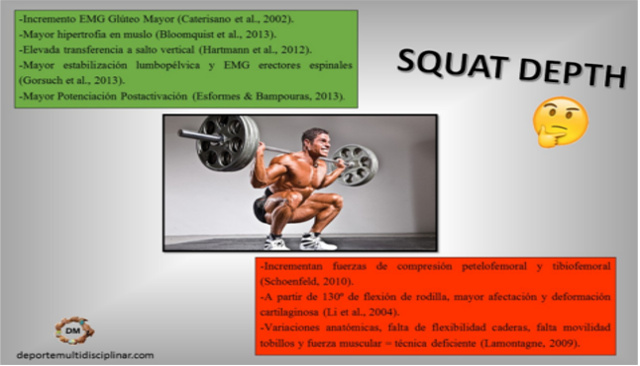
A todo esto, hay que sumarle el concepto de la sentadilla profunda (squat depth) y de si realmente, “es mejor bajar hasta bajo del todo”.
La siguiente infografía se centra precisamente en eso, en resaltar de manera breve y sintética algunos pros y contras sobre la sentadilla profunda que deberíamos de tener en cuenta antes de “bajar hasta bajo del todo”:
1. Bloomquist, K., Langberg, H., Karlsen, S., Madsgaard, S., Boesen, M., & Raastad, T. (2013). Effect of range of motion in heavy load squatting on muscle and tendon adaptations. European Journal Of Applied Physiology, 113(8).
2. Caterisano, A., Moss, R. F., Pellinger, T. K., Woodruff, K., Lewis, V. C., Booth, W., & Khadra, T. (2002). The effect of back squat depth on the EMG activity of 4 superficial hip and thigh muscles. Journal Of Strength And Conditioning Research / National Strength & Conditioning Association, 16(3), 428-432.
3. Esformes, J. I., & Bampouras, T. M. (2013). Effect of back squat depth on lower-body postactivation potentiation. Journal Of Strength And Conditioning Research / National Strength & Conditioning Association, 27(11).
4. Gorsuch, J., Long, J., Miller, K., Primeau, K., Rutledge, S., Sossong, A., & Durocher, J. J. (2013). The effect of squat depth on multiarticular muscle activation in collegiate cross-country runners. Journal Of Strength And Conditioning Research / National Strength & Conditioning Association, 27(9).
5. Hartmann, H., Wirth, K., Klusemann, M., Dalic, J., Matuschek, C., & Schmidtbleicher, D. (2012). Influence of squatting depth on jumping performance. Journal Of Strength And Conditioning Research / National Strength & Conditioning Association, 26(12).
6. Lamontagne, M., Kennedy, M. J., & Beaulé, P. E. (2009). The effect of cam FAI on hip and pelvic motion during maximum squat. Clinical Orthopaedics And Related Research, 467(3), 645-650.
7. Li, G., Zayontz, S., Most, E., DeFrate. L. E., Suggs, J. F. & Rubash, H. E. (2004). In situ forces of the anterior and posterior cruciate ligaments in high knee flexion: an in vitro investigation. Journal of Orthopaedic Research. 22(2):293 – 297.
8. Myer, G, D., Kushner, A, M., Brent, J, L., Schoenfeld, B, J., Hugentobler, J., Lloyd, R, S., Vermeil, A., Chu, D, A., … McGill, S, M. (2014). The back squat: A proposed assessment of functional deficits and technical factors that limit performance. Strength Cond J, 36(6): 4–27.
9. Schoenfeld, B. J. (2010). Squatting kinematics and kinetics and their application to exercise performance. Journal Of Strength And Conditioning Research / National Strength & Conditioning Association, 24(12), 3497-3506.